
WeKnora knowledge bases: from documents to citation checks
When manuals, SOPs and training files are scattered, start with one familiar document and check both answers and citations. Use preparation, parsing and citations as separate checkpoints.
A use case: ask your documents and check the source
A knowledge base retrieves relevant passages before a language model writes an answer. Product manuals, support procedures and training files are useful starting points. Fluent prose does not prove that a citation supports the answer.
The source explains Tencent’s open-source WeKnora and compares the roles of nine knowledge and memory projects. It is a documentation-based tutorial and selection guide, not a controlled performance benchmark.
Prepare the environment and two model connections
- The article uses v0.8.3, with documentation checked on October 14, 2026. This is a historical version reference, not a recommendation of the latest release.
- The Windows route uses Git, Docker Desktop and Linux containers, with available memory, disk space and dedicated ports. Locate and back up an existing installation first.
- Configure a chat model and an embedding model separately. API calls may cost money; check whether internal files may be sent to the chosen service.
- Begin with a small, readable text document. Evaluate scanned PDFs, complex tables and audio separately.
Move beyond a working login page
- Check the selected version, configuration, containers and local health endpoint before opening the login page.
- Create your workspace, test chat and embedding connections, then create a small test knowledge base.
- Upload a document and inspect its parsed preview or chunks after processing finishes.
- Ask a question supported by the file and open its citation. Then ask a question the file does not answer.
- Record versions, backup locations and start/stop steps. Test larger collections and multiple users separately.
Acceptance questions: known and missing information
The article uses a fictional support-training file: respond within two working days after receiving fault photos, with no refund-arrival deadline. This is not an actual company policy.
- A supported question
- “How soon should support respond after receiving the photos?” The answer should match two working days and cite the relevant passage.
- An unsupported question
- “How many days until a refund arrives?” The system should acknowledge that the file does not specify this, rather than invent a deadline.
- What counts as evidence
- Check model connections, parsed content, the answer and its citation. A login page or successful upload alone is insufficient.
Keep purpose, costs and evidence separate
- The article discusses WeKnora, Dify, RAGFlow, AnythingLLM, GBrain, FastGPT, MaxKB, LightRAG and Open WebUI. Choose candidates by the task, then test with your documents.
- The source’s GitHub Stars are a historical attention snapshot, not accuracy, user or purchase counts.
- OCR does not guarantee chart understanding; importing a spreadsheet does not prove formula calculation. Changing embedding models may require reindexing.
- The author reviewed documentation for the official DeepSeek Harness plugin and explicitly did not install or test that integration.
- Model services, storage and maintenance have costs. Check licenses, team permissions, data handling and backups for the intended deployment.
Original article and image attribution
Source: The author’s WeKnora tutorial on WeChat ↗, by Blues, published by Blues19 Cross-border AI on October 15, 2026 at 14:40 Beijing time. This is a summary; consult the Chinese original for full steps and references.
The original Chinese diagram below explains a generic RAG process. It is not a WeKnora interface screenshot or deployment diagram.
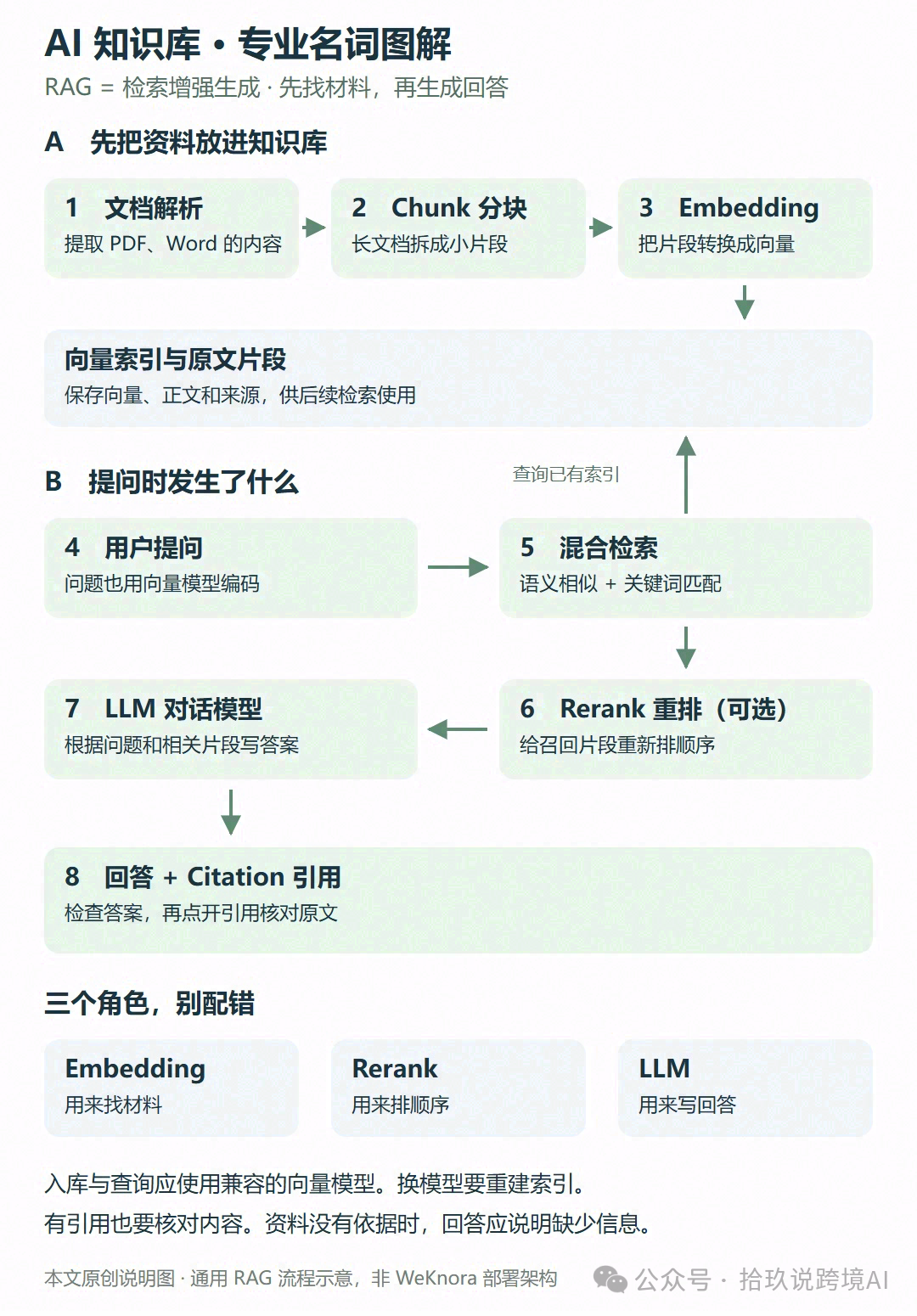
Original Chinese diagram by the article’s author, reproduced without cropping or edits. Documents are parsed and chunked into an index; questions retrieve passages, optional reranking improves their order, and a model produces an answer with citations. Verify citations and acknowledge missing evidence.